An alternative pathway to fixed teeth when conventional implants are not possible
At Ashtree House Dental, we offer zygomatic and pterygoid implant options for suitable patients who have been told they do not have enough bone in their upper jaw for conventional dental implants — and for whom bone grafting may not be the preferred or most appropriate route.
Zygomatic and pterygoid implants are specialist procedures used in complex cases of significant upper jaw bone loss. Rather than anchoring into the conventional alveolar bone of the jaw, these implants engage different — and more abundant — bone structures, providing a stable foundation for full-arch fixed restorations without the need for extensive bone grafting in many cases.
We welcome patients from Wooburn Green, Beaconsfield, High Wycombe, Flackwell Heath and surrounding areas for a consultation and assessment. These treatments require specialist planning and CBCT imaging, and a comprehensive consultation is always the essential first step.
Zygomatic implants are longer than conventional dental implants and are anchored in the zygomatic bone (the cheekbone) rather than in the upper jawbone (maxilla). The cheekbone is a dense, stable structure that retains its volume even when the upper jaw has undergone significant bone resorption.
By anchoring into the cheekbone, zygomatic implants can provide stable support for a full-arch upper prosthesis in patients where conventional implant placement or sinus lifting is not feasible or desired.
Zygomatic implants are placed through the maxilla and into the zygoma under local anaesthetic (with sedation available). They are used in conjunction with conventional anterior implants, or with pterygoid implants, to provide multi-point support for a fixed prosthesis.
Because zygomatic implants engage bone that is remote from the atrophied maxillary ridge, they often make it possible to provide fixed, implant-supported teeth in a single surgical stage — without the prolonged healing periods associated with extensive bone grafting.
Pterygoid implants — also called tuberosity or pterygo-maxillary implants — are placed into the pterygoid process of the sphenoid bone and/or the maxillary tuberosity, at the posterior (rear) of the upper jaw. This area of bone is typically more dense than the resorbed anterior ridge and is not affected by the maxillary sinus.
Pterygoid implants can be used alongside conventional or zygomatic implants to provide posterior support for a full-arch upper prosthesis, often avoiding the need for a sinus lift procedure at the back of the upper jaw.
These techniques are considered in specific clinical situations, including:
These are not first-line implant treatments — they are specialist options for cases where standard approaches are insufficient. A thorough clinical and radiographic assessment is essential to determine whether you may be a suitable candidate.
Both zygomatic/pterygoid implants and bone grafting approaches (such as a sinus lift) can help patients with upper jaw bone loss achieve fixed tooth replacement. They are different pathways, each with its own considerations:
Bone grafting/sinus lift involves rebuilding the available bone in the jaw over several months, after which conventional implants can be placed. This staged approach takes longer overall but uses the patient’s own jaw for support.
Zygomatic/pterygoid implants bypass the resorbed jaw by anchoring in remote, dense bone structures. This can reduce or eliminate the need for grafting, and in suitable patients, a provisional fixed bridge may be fitted at or shortly after surgery — potentially reducing overall treatment time.
Your dentist will discuss both pathways and which may be more appropriate for your specific anatomy, health, and goals during your consultation.
A full clinical consultation, comprehensive CBCT imaging, and in some cases specialist involvement in treatment planning. The CBCT scan allows three-dimensional assessment of the cheekbone, pterygoid region, sinus anatomy, and remaining jaw bone to plan implant trajectories with precision.
A detailed, personalised treatment plan is produced and discussed with you. The number and type of implants, the prosthesis design, and the surgical approach are all planned carefully before any procedure takes place. A full written cost plan is provided.
Zygomatic and pterygoid implant surgery is carried out under local anaesthetic, with conscious sedation available. The procedures are more complex than standard implant placement, and the surgical appointment is correspondingly longer. In many cases, a provisional fixed bridge can be fitted at the time of, or shortly following, surgery.
A period of healing is required following surgery. Follow-up imaging and clinical review are arranged to monitor progress.
Once integration is confirmed and healing is complete, the final custom-made prosthesis is fabricated and fitted. The design and material of the final restoration will be discussed with you in advance.
No. Zygomatic and pterygoid implants are specialist techniques used in specific clinical situations. Not every patient with upper jaw bone loss will be a candidate. Factors including the degree and pattern of bone loss, sinus anatomy, facial skeletal structure, and general health all influence suitability.
Some patients may be better served by bone grafting and conventional implants, by an All-on-4 approach using angled conventional implants, or — in cases where implant treatment is not feasible — by a high-quality implant-retained prosthesis.
Your dentist will assess all of these options and provide honest guidance on what is clinically appropriate for your individual situation.
These are specialist procedures requiring detailed planning, advanced surgical skill and specialist materials. The cost is accordingly higher than conventional implant treatment. We will always provide a detailed, written cost plan before any treatment begins. Flexible finance options may be available.
Specialist implant treatment requires specialist care. Here is what you can expect when you come to us:
Clinician-led treatment — zygomatic and pterygoid implant treatment is planned and delivered by an experienced clinician, with specialist input where required.
Thorough consultations — we carry out comprehensive CBCT imaging and a detailed clinical assessment before recommending any treatment pathway.
Personalised treatment planning — the number and type of implants, the prosthesis design and the surgical approach are all planned carefully around your anatomy and clinical situation.
Honest advice — not everyone with bone loss is a candidate for zygomatic or pterygoid implants. We will discuss all available options and be straightforward about what is and is not appropriate for your situation.
Ongoing aftercare and support — we arrange follow-up imaging, clinical review and regular professional maintenance to support long-term outcomes.
If you have been told you do not have enough bone for conventional dental implants, or if you would like to explore your options in Wooburn Green, Beaconsfield, High Wycombe or Flackwell Heath, we encourage you to come in for an assessment.
We will review your situation, carry out appropriate imaging, and provide honest, clear guidance on what may be possible for you.
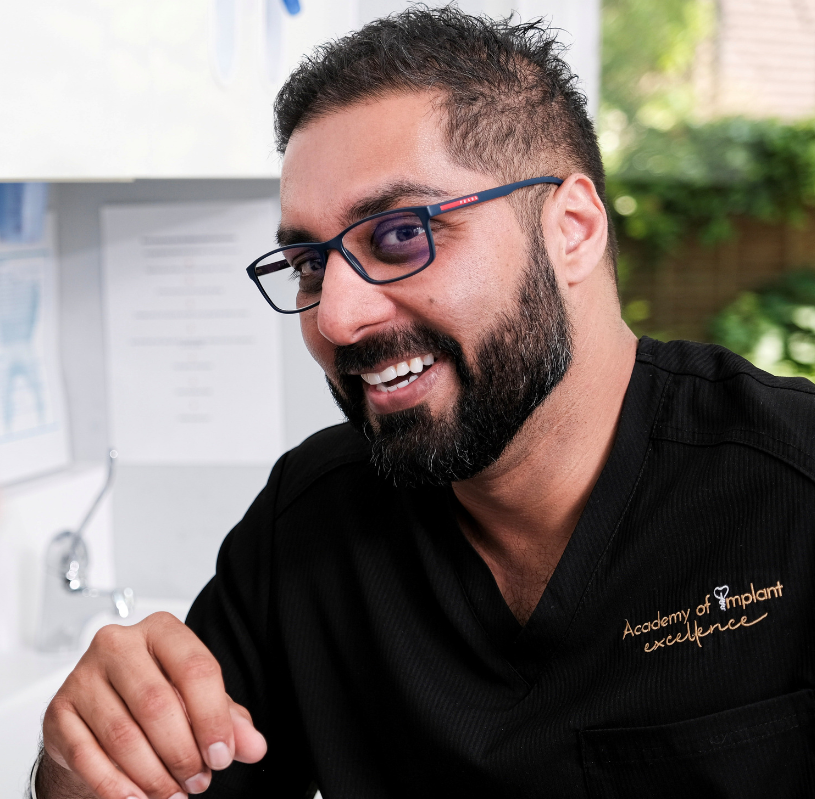
Commonly known as Dr Pav Khaira is a highly prominent British dental implant surgeon, lecturer, and mentor with over 20 years of focused clinical experience. He is widely recognised in the UK dental community for handling complex restorative cases and is affectionately nicknamed “The Titani-Nerd” or the “Wikipedia of Implantology” due to his deep obsession with implant science.
He graduated with a BDS from the University of London in 2002, later earning an MJDF RCS (Eng) and a Master of Clinical Dentistry (MClinDent) in Implant Dentistry with distinction.
Dr Khaira specialises in treating patients who have been told they lack sufficient bone or have cases too complex for standard treatments.
The procedure is more complex and the surgical time is longer than for conventional implants. However, from the patient’s perspective, both are performed under local anaesthetic (with sedation available), and the recovery process — though more involved — follows a similar pattern of post-surgical soreness and swelling.
In many zygomatic and pterygoid implant cases, a provisional fixed bridge can be attached at the time of surgery or shortly after, meaning patients do not need to go without teeth. This provisional restoration is replaced with the final prosthesis once healing is complete.
Not necessarily. Zygomatic and pterygoid implants are specifically designed for cases where conventional implants cannot be placed due to bone loss. However, suitability still depends on many factors. The only way to determine whether you may be a candidate is through a consultation and CBCT imaging assessment.
Zygomatic implants have been used in clinical practice for over two decades and have a well-documented track record in appropriate patients. Long-term success is dependent on patient health, oral hygiene, and regular professional maintenance — as with any implant-supported restoration.
Yes — we offer zygomatic and pterygoid implant planning and treatment for suitable patients. Where specialist surgical input is required, we will discuss the most appropriate pathway with you and can provide referral where needed.