Fixed, non-removable teeth — often in a single day
At Ashtree House Dental, we offer full mouth rehabilitation using the All-on-4 and All-on-6 implant systems. These are well-established techniques for patients who have lost most or all of their teeth in an arch, or who are facing the loss of remaining failing teeth and wish to replace them with a fixed, permanent solution.
Unlike conventional dentures, All-on-4 and All-on-6 restorations are anchored securely into the jawbone and cannot be removed by the patient. They provide a stable, functional and natural-looking solution that allows patients to eat, speak and smile with confidence.
We welcome patients from Wooburn Green, Beaconsfield, High Wycombe, Flackwell Heath and surrounding areas. A thorough assessment — including clinical examination and CBCT imaging — is always required before treatment is planned.
All-on-4 and All-on-6 are implant-supported full-arch restoration techniques in which a fixed bridge or prosthesis is supported by either four or six strategically placed dental implants per jaw.
All-on-4 uses four implants per arch. In this technique, two implants are placed vertically at the front of the jaw, and two implants are placed at an angle (typically 45 degrees) towards the back. The angled posterior implants are longer and engage more bone, which in many cases eliminates the need for bone grafting. A provisional fixed bridge can often be fitted on the same day as implant surgery — hence the term frequently used to describe this approach: “fixed teeth in a day.”
All-on-6 uses six implants per arch, providing additional support points. This approach may be recommended where greater stability is needed, where the bone distribution warrants additional implants, or where a larger prosthesis is planned. All-on-6 is often associated with improved long-term load distribution across the restoration.
Your dentist will assess which approach is most appropriate for your jaw structure, bone volume and clinical situation.
All-on-4 / All-on-6 may be appropriate if you:
Factors that may affect suitability or increase risk:
A detailed medical and dental assessment — including CBCT imaging — is always required before any treatment is planned.
A comprehensive consultation including clinical examination, dental and medical history review, and CBCT imaging to assess bone volume, bone quality, and the position of vital anatomical structures. We will discuss your goals, the treatment options available to you, and the expected treatment pathway. A full written cost plan is provided before you proceed.
Where remaining teeth need to be removed, this is planned as part of the overall treatment sequence. In many All-on-4 / All-on-6 cases, extractions and implant placement are carried out at the same surgical appointment.
Implants are placed under local anaesthetic. Sedation is available for anxious patients. In most All-on-4 / All-on-6 cases, a provisional fixed bridge — sometimes referred to as a provisional prosthesis — is attached to the implants on the same day, allowing you to leave the practice with a functional set of fixed teeth.
The provisional bridge is worn while the implants integrate with the surrounding bone — a process that typically takes four to six months. During this time, review appointments are arranged to monitor healing and progress.
Once osseointegration is confirmed and healing is complete, the final custom-made prosthesis is fabricated. This may be a fixed implant-supported bridge made from ceramic, zirconia or a combination of materials. Your dentist will discuss the options with you. The final restoration is fitted and adjusted to ensure comfort, function and appearance are optimal.
Both techniques use the same fundamental principle of supporting a full-arch prosthesis on a small number of strategically placed implants. The choice between four and six implants depends on clinical factors including bone anatomy, the size of the jaw, and the design of the planned restoration.
Your dentist will assess your specific anatomy and discuss the clinical rationale for the recommended approach during your consultation. Both systems have a well-established track record when appropriate patient selection criteria are met.
All-on-4 / All-on-6 prostheses are fixed — they are screwed onto the implants and can only be removed by a dentist. They do not move or lift when eating or speaking.
Implant-retained dentures are removable — they clip onto implants for stability but can be taken out by the patient for cleaning. They are generally less expensive and require fewer implants, but do not provide the same level of stability or the same feel as a fixed restoration.
At Ashtree House Dental, we also offer the SynCone implant-retained denture system for patients who prefer a removable option or where a fixed approach is not appropriate. Your dentist will discuss both options with you.
With appropriate maintenance, implant-supported full-arch restorations can last for many years. The implants themselves are designed as a long-term solution. The prosthesis — the bridge or denture component — may require maintenance or replacement at some stage. Regular professional cleaning and check-up appointments are important for the long-term success of any implant-supported restoration.
Full-arch implant treatment represents a significant investment. Costs vary depending on the number of implants, the type and material of the final prosthesis, whether extractions or preparatory procedures are needed, and whether treatment is being carried out on one or both jaws. We will always provide a detailed, transparent written cost plan before treatment begins. Flexible finance options may be available.
Full mouth rehabilitation is a significant undertaking. Here is what you can expect when you come to us:
Clinician-led treatment — your implant treatment is planned and delivered by an experienced clinician, not delegated to non-clinical staff.
Thorough consultations — we take the time to fully assess your suitability, including CBCT imaging and a detailed review of your dental and medical history.
Personalised treatment planning — whether All-on-4, All-on-6 or an alternative approach is most appropriate, your plan is tailored to your anatomy, your oral health and your circumstances.
Honest advice — if full arch implants are not the most appropriate route for you, we will tell you. We discuss all suitable options and provide transparent written cost plans before any treatment begins.
Ongoing aftercare and support — we provide structured aftercare guidance and arrange regular professional maintenance appointments to support the long-term success of your implants.
If you are considering full mouth rehabilitation with All-on-4 or All-on-6 implants in Wooburn Green, Beaconsfield, High Wycombe or Flackwell Heath, we encourage you to come in for a consultation.
We will carry out a thorough assessment, discuss all of the options available to you, and provide honest, personalised advice. There is no obligation to proceed.
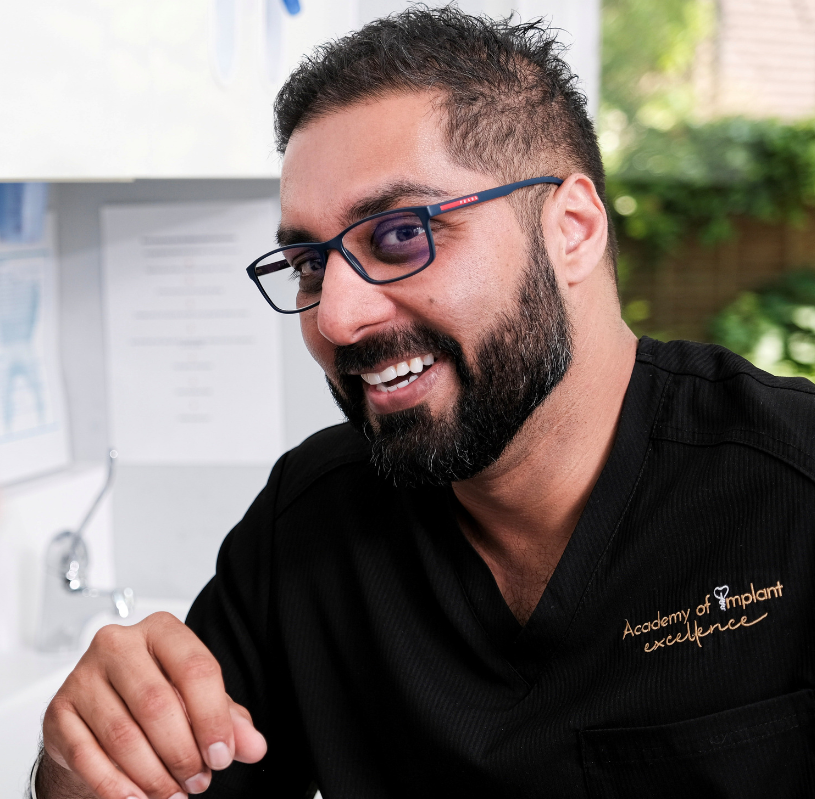
Commonly known as Dr Pav Khaira is a highly prominent British dental implant surgeon, lecturer, and mentor with over 20 years of focused clinical experience. He is widely recognised in the UK dental community for handling complex restorative cases and is affectionately nicknamed “The Titani-Nerd” or the “Wikipedia of Implantology” due to his deep obsession with implant science.
He graduated with a BDS from the University of London in 2002, later earning an MJDF RCS (Eng) and a Master of Clinical Dentistry (MClinDent) in Implant Dentistry with distinction.
Dr Khaira specialises in treating patients who have been told they lack sufficient bone or have cases too complex for standard treatments.
In most cases, yes — a provisional fixed bridge is fitted on the same day as implant surgery. This is not your final permanent restoration, but it is fixed and functional. You should follow dietary guidance during the healing period (typically softer foods while the implants integrate).
During the initial healing period, a softer diet is recommended to protect the implants as they integrate. Your dentist will advise on dietary guidelines. Most patients are able to return to a broader diet once final restorations are fitted.
Possibly. The angled implant placement used in All-on-4 / All-on-6 is specifically designed to utilise available bone where conventional implant positioning is not possible. In some cases of severe bone loss, zygomatic or pterygoid implants may be considered. A CBCT scan is essential to assess bone volume accurately.
Implant placement is carried out under local anaesthetic. Post-surgical discomfort, swelling and bruising are expected, but most patients find the recovery manageable. Sedation is available for anxious patients.
Careful oral hygiene is essential. Interdental brushes, water flossers and specific implant cleaning aids are typically recommended alongside twice-daily brushing. Your team will provide full guidance on maintaining your implants.
This is possible in some cases and can be discussed during your consultation. Your dentist will advise on the most appropriate sequence based on your clinical situation and recovery capacity.